
“I have lung fibrosis and have now been diagnosed with lung cancer. Can I have surgery?” When these conditions occur together, treatment requires careful planning. Lung scarring (fibrosis) does not automatically rule out every treatment. We need to assess the cancer, lung function and the person's overall health together.
Related videos and posts
Video: Treatment options after a lung cancer diagnosis — Instagram, in Turkish
This video discusses general lung cancer assessment. It does not replace an individual assessment for interstitial lung disease.
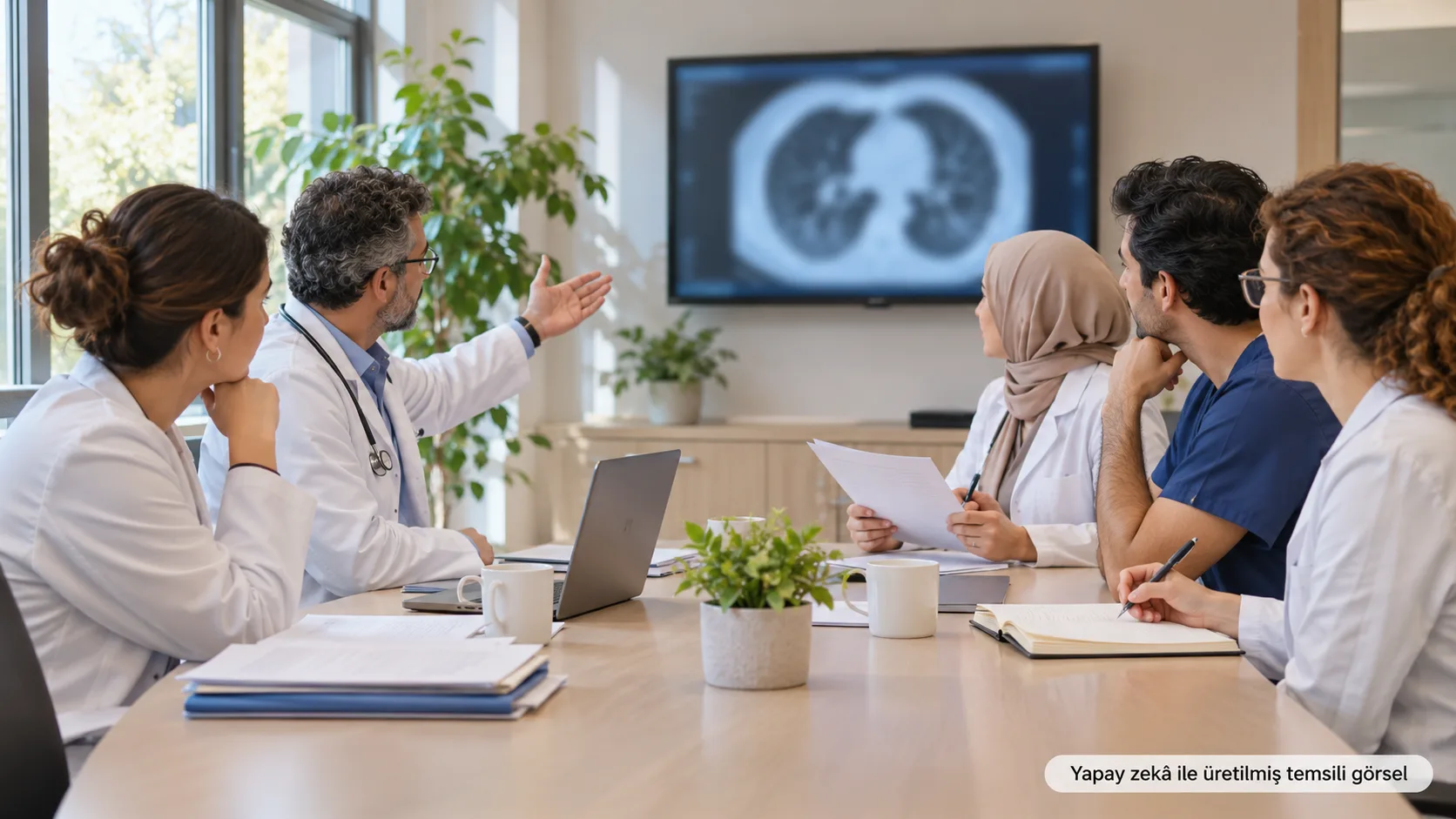
What is lung scarring (fibrosis)?
Interstitial lung disease is a group of conditions affecting the tissue around the air sacs in the lungs. Some cause thickening and scarring, known as fibrosis.
These conditions are not all the same. Idiopathic pulmonary fibrosis is one particular type. The word “fibrosis” in a report is therefore not enough to decide how to treat a person's cancer.
What did our research show?
In our retrospective study, published in Medicine in 2024 with me as first author, we reviewed treatment options for patients with both interstitial lung disease and lung cancer.
Hospital and respiratory intensive care stays were shorter in the surgical group. However, there was no statistically significant difference between groups in two- and four-year survival.
This does not mean everyone should have surgery. Treatment was not randomly assigned, and differences in patients' health and cancer stage may have influenced the findings. The main message is to make an individual plan that addresses cancer control while considering the risks of the underlying lung disease. See our study's PubMed record for the published abstract.
What does the new European guideline say?
The European Respiratory Society guideline published on 19 November 2026 specifically addresses patients with idiopathic pulmonary fibrosis and lung cancer.
It suggests considering surgery for medically fit patients with early-stage cancer, while emphasising preoperative assessment, the risk of a sudden worsening of lung disease and patient preferences.
Our study and the guideline share an emphasis on individual treatment selection. Their populations are not identical: our study covers a broader interstitial lung disease population, while the guideline focuses on idiopathic pulmonary fibrosis. Its recommendations are conditional and do not mean everyone should receive the same treatment.
How do we make decisions at the consultation and tumour board?
When you attend with suspected or diagnosed lung cancer, I review your CT images, any PET-CT scans and any biopsy results from the lung mass. We assess whether further tests or another biopsy are needed.
At the thoracic tumour boards at Medipol Acıbadem District Hospital and Medipol Mega University Hospital, we bring together specialists in Respiratory Medicine, Thoracic Surgery, Medical Oncology, Radiation Oncology, Radiology, Interventional Radiology and Nuclear Medicine.
If surgery is suitable, we discuss the operation and its risks. If medicines or radiotherapy are needed, we plan their suitability and timing with the relevant specialists. With lung fibrosis, we also consider the additional risks associated with each option. We discuss the board's recommendation alongside your preferences and expectations.
What should you bring to the appointment?
Bring any CT and PET-CT images, biopsy reports, lung function results and a list of your medicines. You can read my lung cancer assessment and treatment guide for further background.
If you have interstitial lung disease and a lung mass or lung cancer, you can seek assessment from Respiratory Medicine and Thoracic Surgery specialists. To review your mass, imaging and any biopsy result, discuss whether further biopsy is needed and consider whether surgery is suitable alongside other tumour board options, contact me for an appointment.
This article provides general information and does not replace an individual medical consultation.
Sources
- Karapinar K et al. Selection of the appropriate treatment for the combination of interstitial lung disease and lung cancer: A retrospective observational study. Medicine. 2024;103(6):e37186. DOI: 10.1097/MD.0000000000037186.
- Tzouvelekis A et al. ERS clinical practice guidelines for the management of patients with idiopathic pulmonary fibrosis and lung cancer. European Respiratory Journal. 19 November 2026. DOI: 10.1183/13993003.01271-2026.
Study and guideline findings in this article are based on their published abstracts.